 Sentinel Alcohol Detox

Sagent Behavioral Health — 1101 78Th Street East, Suite 100
1.4 mi, Minneapolis1101 78th Street East, Suite 100, Minneapolis, MN, 55420
Active
- Day treatment
- Medication-assisted treatment
- Medicaid
- Medicare
City
No listed facilities are in Richfield. The nearest listed facility is 1.4 miles from Richfield. Compare the facilities near Richfield below; distances are straight-line estimates.
This number connects to our central helpline, not directly to a listed facility.
If you're looking for alcohol rehabilitation in or near Richfield, you may be facing a difficult moment and wondering what to do first. A typical first day at a program begins with an assessment to understand your alcohol use, any medical needs, and what type of care might help you. From there, you'll work with staff to decide on a plan, which could include outpatient sessions, counseling, or other services.
Call the programs you're considering to ask about their admission process, what documents you need to bring, and whether you can start the same day.

Choosing between care levels depends on your situation. Use detox if you have had severe withdrawal before, drink daily, or have other health problems. Residential is best if your home environment makes it hard to stay sober, or if you have tried outpatient and relapsed.
Outpatient works well when you have a stable home, supportive people around, and a mild or moderate drinking problem. An addiction medicine provider can match you to the right level after a medical and mental health assessment. Don't worry about picking the wrong one; many programs allow you to transfer between levels if needed.
"Do you help with discharge planning, such as arranging follow-up care or housing?"
In Minnesota, alcohol rehab is frequently paid for through private health insurance plans, whether employer-based or purchased independently. Government-funded programs like Medical Assistance and MinnesotaCare may help cover costs for qualifying residents; however, you should always confirm coverage and enrollment details with the program and the rehab center. Sliding-scale fees are a common option for those with limited income, and self-pay arrangements are also typical.
To avoid surprises, verify all payment information, including accepted insurance and financial aid policies, directly with the facility.
Reach our free, confidential helpline any time, day or night.
A short conversation helps match you with the right level of care.
If needed, withdrawal is managed safely under medical supervision.
You leave with a clear plan for ongoing treatment and support.
Make sure the program fits your specific needs. For example, if you take medication for depression or anxiety, confirm the doctors know how to handle that combination. If you have children, ask whether they allow visits or have family program options.
Look at the location: a rural setting might feel safer and remove triggers, but an urban center can make it easier to attend medical appointments. Check whether they accept Medicaid or sliding-scale fees if you do not have private insurance. Ask about the daily structure—too much free time can be hard early in recovery.
Finally, ask for a written discharge plan so you know what happens after treatment ends.
If you're looking for alcohol rehabilitation in or near Richfield, you may be facing a difficult moment and wondering what to do first.

You do not have to wait until you are in crisis. But if you are already having severe symptoms—racing pulse, vomiting, confusion, or seeing things that are not real—get to an ER now. Call 911 if you cannot get there safely.
Let the paramedics or doctors know you drink alcohol every day and stopped. They have medications to prevent dangerous complications. Emergency medical care is always the right first step.
Once you are out of danger, they can help you plan next steps for recovery.
If you or someone else is in immediate danger, call 911 now.
1101 78th Street East, Suite 100, Minneapolis, MN, 55420
Active
1100 East 80th Street, Minneapolis, MN, 55420
Active
1801 American Boulevard, Minneapolis, MN, 55425
Active
7701 York Avenue South, Suite 350, Minneapolis, MN, 55435
Active
8040 Old Cedar Avenue South, Suite 101, Minneapolis, MN, 55425
Active
8040 Old Cedar Avenue South, Suite 100, Minneapolis, MN, 55425
Active
3400 West 66th Street, Suite 400, Minneapolis, MN, 55435
Active
6600 France Avenue South, Suite 230, Minneapolis, MN, 55435
Active
6600 France Avenue South, Suite 425, Minneapolis, MN, 55435
Active
2626 East 82nd Street, Suite 305, Minneapolis, MN, 55425
Active
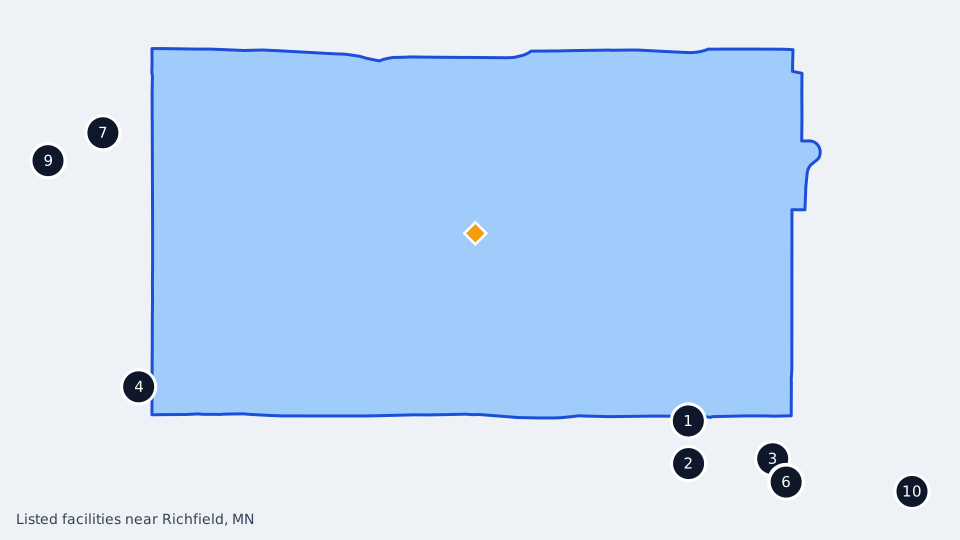
These lists use only what the 10 active facilities listed for Richfield report to SAMHSA's FindTreatment.gov. No facility pays to be included or can ask to be moved. Reporting more options is not a measure of quality, outcomes or suitability for any person. A missing option means the facility did not report it to the source, not that it is not offered. Call the facility to confirm everything before relying on it.
How this list is made: each facility scores one point for each of these 5 levels of care (settings) it reports to SAMHSA's FindTreatment.gov (Residential (24-hour); Outpatient; Intensive outpatient; Partial hospitalization / day treatment; Hospital inpatient). A facility needs at least 3 to appear. Facilities are shown from the highest count to the lowest; facilities with the same count are in alphabetical order, which has no other meaning. Up to 10 are shown.
How this list is made: each facility scores one point for each of these 7 payment and cost-assistance options it reports to SAMHSA's FindTreatment.gov (Medicaid; Medicare; Private health insurance; Military insurance (TRICARE); Cash or self-payment; Sliding fee scale; Payment assistance). A facility needs at least 4 to appear. Facilities are shown from the highest count to the lowest; facilities with the same count are in alphabetical order, which has no other meaning. Up to 10 are shown.
How this list is made: each facility scores one point for each of these 4 medications used in treatment it reports to SAMHSA's FindTreatment.gov (Buprenorphine; Methadone; Naltrexone; Medication for alcohol use disorder). A facility needs at least 2 to appear. Facilities are shown from the highest count to the lowest; facilities with the same count are in alphabetical order, which has no other meaning. Up to 10 are shown.
How this list is made: each facility scores one point for each of these 12 age groups and client groups accepted it reports to SAMHSA's FindTreatment.gov (Adolescents; Young adults; Adults; Seniors; Pregnant or postpartum women; Adult women; Adult men; Veterans; Active duty military; Criminal justice clients; Clients who have experienced trauma; Co-occurring mental and substance use disorders). A facility needs at least 5 to appear. Facilities are shown from the highest count to the lowest; facilities with the same count are in alphabetical order, which has no other meaning. Up to 10 are shown.
Programs may offer outpatient treatment, intensive outpatient programs, or residential care. Call a program directly to learn which levels of care it provides and whether they fit your situation.
Ask about the program's approach to treatment, the length of its program, and what a typical day looks like. It helps to confirm they treat alcohol use specifically and to discuss any other needs you have during a phone call.
A typical timeline is: detox 3–7 days, residential 30–90 days, outpatient 3–6 months. But many programs are individualized. Some people need more time, some less. The key is to stay engaged until you and your treatment team agree you are stable.
Many plans do, but you need to check. Start by calling the program you are interested in and asking their admissions team if they accept your insurance. They can usually run a quick verification. If you have no insurance, ask about state-funded options or sliding-scale fees based on your income.
Yes, you have options. For mild to moderate alcohol problems, outpatient rehab can fit around a work schedule. For more severe cases, residential care means a temporary stay; you can request a medical leave of absence. Many companies are understanding, and your treatment team can provide documentation if needed.
Last updated