 Sentinel Alcohol Detox

Harmony House
0.5 mi, New Bedford234 Earle Street, New Bedford, MA, 02746
Active
- Residential
- Medicaid
- Medicare
- Private insurance
City
10 options near New Bedford, MA, nearest first. Compare services and locations, then call to check availability.
This number connects to our central helpline, not directly to a listed facility.
If you are looking for help with an alcohol problem in or near New Bedford, the first step is usually an assessment to understand your needs and what kind of care might be right for you. Call any program you are considering to ask what their intake process involves, what documents you need to bring, and whether they offer medical supervision for withdrawal or ongoing support. Programs may have different approaches, so it helps to ask about their philosophy and what a typical day looks like.

Not everyone needs every level. Detox is for people who will have physical withdrawal symptoms like shaking, sweating or confusion. Residential is for those who need to step away from triggers and focus only on recovery for a while.
Outpatient includes several types: intensive programs (9 or more hours a week) and standard programs (a couple of hours weekly). Ask yourself: can you stop drinking safely on your own? If no, detox first.
Do you have a stable, sober place to go home each night? If no, consider residential.
What happens after the program ends — do you provide an aftercare plan or connect me with local support groups? Check if they offer recovery coaching, alumni meetings, or referrals to therapists.
Across Massachusetts, many individuals pay for alcohol rehab through private health insurance plans, including those obtained through employers or the state's Health Connector. Public coverage, such as MassHealth (the state's Medicaid program) and Medicare, may also help cover treatment costs for those who qualify; it is important to confirm your eligibility directly with the program. Additionally, many facilities offer sliding-scale fees based on income, and self-pay options are typically available for those without insurance or who prefer to pay out-of-pocket.
Always verify payment arrangements directly with the facility before admission.
The cost and payment options can guide your decision. Some programs accept your health insurance, others offer sliding scale fees or payment plans. Ask if they have experience with your specific situation.
For example, if you have had relapses before, ask how they handle that. Look at the staff qualifications. Are counselors licensed and certified?
Does a medical director oversee detox? Read any materials they give you, including the discharge planning section. A program that starts planning your next step from day one shows they care about long-term results.
If you are looking for help with an alcohol problem in or near New Bedford, the first step is usually an assessment to understand your needs and what kind of care might be right for you.

Alcohol withdrawal can kill. If you are sweating, vomiting, see things that are not there or feel your heart racing, go to the ER. Do not try to drink a little to calm the symptoms.
Do not take any medication without a doctor. An emergency room can safely manage withdrawal with FDA-approved drugs. Once you are stable, they can help you find a rehab center.
This is the smartest, safest thing you can do right now.
If you or someone else is in immediate danger, call 911 now.
234 Earle Street, New Bedford, MA, 02746
Active
68 North Front Street, New Bedford, MA, 02740
Active
8 Kilburn Street, New Bedford, MA, 02740
Active
979 Pleasant Street, New Bedford, MA, 02740
Active
888 Purchase Street, Suite 402, New Bedford, MA, 02740
Active
33 South 6th street, New Bedford, MA, 02740
Active
965 Church Street, New Bedford, MA, 02745
Active
92 Grape Street, New Bedford, MA, 02740
Active
226 Field Street, New Bedford, MA, 02740
Active
34 Gifford Street, New Bedford, MA, 02744
Active
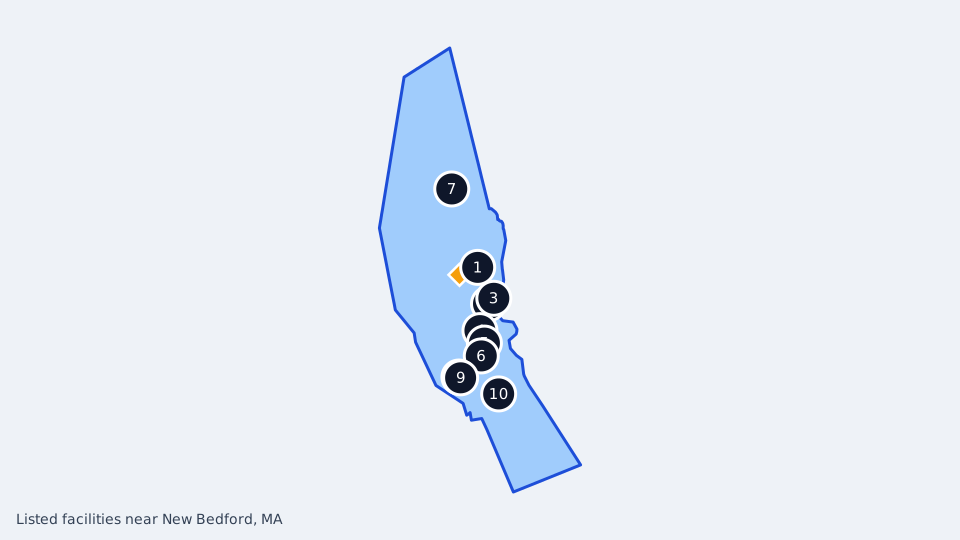
These lists use only what the 10 active facilities listed for New Bedford report to SAMHSA's FindTreatment.gov. No facility pays to be included or can ask to be moved. Reporting more options is not a measure of quality, outcomes or suitability for any person. A missing option means the facility did not report it to the source, not that it is not offered. Call the facility to confirm everything before relying on it.
How this list is made: each facility scores one point for each of these 7 payment and cost-assistance options it reports to SAMHSA's FindTreatment.gov (Medicaid; Medicare; Private health insurance; Military insurance (TRICARE); Cash or self-payment; Sliding fee scale; Payment assistance). A facility needs at least 4 to appear. Facilities are shown from the highest count to the lowest; facilities with the same count are in alphabetical order, which has no other meaning. Up to 10 are shown.
How this list is made: each facility scores one point for each of these 4 medications used in treatment it reports to SAMHSA's FindTreatment.gov (Buprenorphine; Methadone; Naltrexone; Medication for alcohol use disorder). A facility needs at least 2 to appear. Facilities are shown from the highest count to the lowest; facilities with the same count are in alphabetical order, which has no other meaning. Up to 10 are shown.
How this list is made: each facility scores one point for each of these 12 age groups and client groups accepted it reports to SAMHSA's FindTreatment.gov (Adolescents; Young adults; Adults; Seniors; Pregnant or postpartum women; Adult women; Adult men; Veterans; Active duty military; Criminal justice clients; Clients who have experienced trauma; Co-occurring mental and substance use disorders). A facility needs at least 5 to appear. Facilities are shown from the highest count to the lowest; facilities with the same count are in alphabetical order, which has no other meaning. Up to 10 are shown.
Programs may offer different levels of care, such as residential treatment, outpatient counseling, medication-assisted treatment, or recovery support groups. Since services vary by program, call each one to ask what they provide and what their approach is.
Think about your personal needs, like whether you need medical supervision for withdrawal or flexible scheduling for work or family. Then call programs directly to ask about their admission process, services offered, and what you can expect during treatment.
Yes, that is the main benefit of outpatient care. However, intensive outpatient programs require 9 to 20 hours per week, usually during the day or evening. Standard outpatient may need only 1 or 2 hours per week. Check the schedule with the program to see if it fits your job.
Treatment is generally private. You can use FMLA leave for medical reasons without specifying the condition. Many employers have employee assistance programs that keep information confidential. Check the rehab's privacy policy. They cannot share your information without your written permission, except in rare legal situations.
Costs vary widely. Detox may cost $500 to $1,500 per day, while residential can be $10,000 to $60,000 per month. Outpatient programs may charge $100 to $500 per session. Many programs offer sliding scale fees, payment plans, or state-funded grants. Always ask about financial options before enrolling.
Last updated