 Sentinel Alcohol Detox

South County Youth Services
1.7 mi, Alexandria8350 Richmond Highway, Suite 515, Alexandria, VA, 22310
Active
- Outpatient
- Medication-assisted treatment
- Medicaid
- Medicare
City
No listed facilities are in Hybla Valley. The nearest listed facility is 1.7 miles from Hybla Valley. Compare the facilities near Hybla Valley below; distances are straight-line estimates.
This number connects to our central helpline, not directly to a listed facility.
If you live in or near Hybla Valley and are looking for help with alcohol use, the first step is learning what each program offers. On your first day at a rehab center, you can expect an assessment to understand your needs and discuss what treatment options are available to you.

Not everyone needs every level. Detox is for people who will have physical withdrawal symptoms like shaking, sweating or confusion. Residential is for those who need to step away from triggers and focus only on recovery for a while.
Outpatient includes several types: intensive programs (9 or more hours a week) and standard programs (a couple of hours weekly). Ask yourself: can you stop drinking safely on your own? If no, detox first.
Do you have a stable, sober place to go home each night? If no, consider residential.
What happens after the program ends — do you provide an aftercare plan or connect me with local support groups? Check if they offer recovery coaching, alumni meetings, or referrals to therapists.
In Virginia, individuals often fund alcohol rehab services through private health insurance plans, including employer-provided and individual marketplace policies, which may cover detoxification, residential care, and outpatient therapy. Public coverage such as Medicaid and Medicare is available for eligible residents, offering access to accredited programs, though benefits and provider networks vary, so confirming coverage before admission is essential. Many centers offer sliding-scale fees based on income and financial need, alongside self-pay options for those without insurance or with out-of-network care.
Reach our free, confidential helpline any time, day or night.
A short conversation helps match you with the right level of care.
If needed, withdrawal is managed safely under medical supervision.
You leave with a clear plan for ongoing treatment and support.
The cost and payment options can guide your decision. Some programs accept your health insurance, others offer sliding scale fees or payment plans. Ask if they have experience with your specific situation.
For example, if you have had relapses before, ask how they handle that. Look at the staff qualifications. Are counselors licensed and certified?
Does a medical director oversee detox? Read any materials they give you, including the discharge planning section. A program that starts planning your next step from day one shows they care about long-term results.
If you live in or near Hybla Valley and are looking for help with alcohol use, the first step is learning what each program offers.

Alcohol withdrawal can kill. If you are sweating, vomiting, see things that are not there or feel your heart racing, go to the ER. Do not try to drink a little to calm the symptoms.
Do not take any medication without a doctor. An emergency room can safely manage withdrawal with FDA-approved drugs. Once you are stable, they can help you find a rehab center.
This is the smartest, safest thing you can do right now.
If you or someone else is in immediate danger, call 911 now.
8350 Richmond Highway, Suite 515, Alexandria, VA, 22310
Active
6901 South Van Dorn Street, Alexandria, VA, 22315
Active
120 South Payne Street, Alexandria, VA, 22314
Active
1729 King Street, Suite 300, Alexandria, VA, 22314
Active
316 Lismore Drive, Fort Washington, MD, 20744
Active
10905 Fort Washington Road, Suite 105, Fort Washington, MD, 20744
Active
6210 Old Franconia Road, Unit A, Alexandria, VA, 22310
Active
4850 Mark Center Drive, Alexandria, VA, 22311
Active
5400 Shawnee Road, Suite 101, Alexandria, VA, 22312
Active
6563 Edsall Road, Springfield, VA, 22151
Active
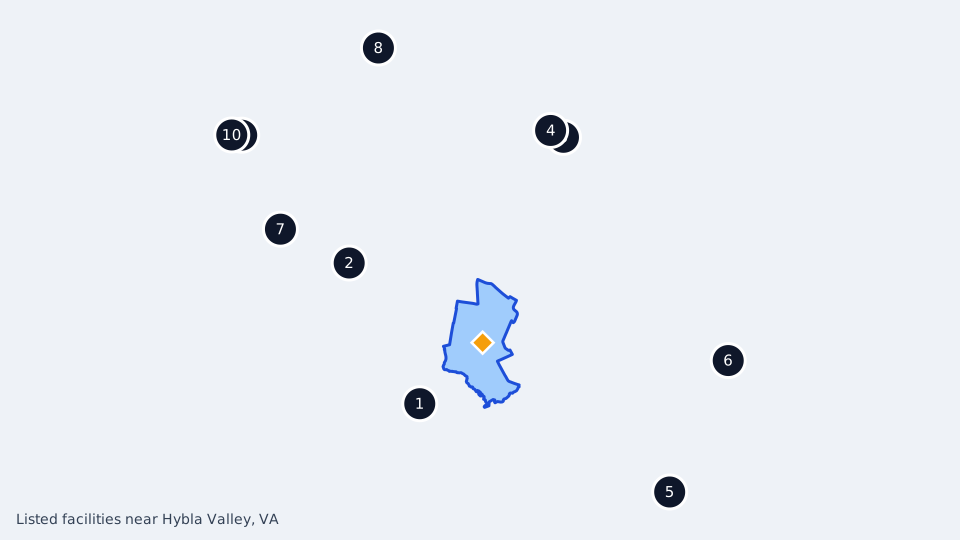
These lists use only what the 10 active facilities listed for Hybla Valley report to SAMHSA's FindTreatment.gov. No facility pays to be included or can ask to be moved. Reporting more options is not a measure of quality, outcomes or suitability for any person. A missing option means the facility did not report it to the source, not that it is not offered. Call the facility to confirm everything before relying on it.
How this list is made: each facility scores one point for each of these 5 levels of care (settings) it reports to SAMHSA's FindTreatment.gov (Residential (24-hour); Outpatient; Intensive outpatient; Partial hospitalization / day treatment; Hospital inpatient). A facility needs at least 3 to appear. Facilities are shown from the highest count to the lowest; facilities with the same count are in alphabetical order, which has no other meaning. Up to 10 are shown.
How this list is made: each facility scores one point for each of these 7 payment and cost-assistance options it reports to SAMHSA's FindTreatment.gov (Medicaid; Medicare; Private health insurance; Military insurance (TRICARE); Cash or self-payment; Sliding fee scale; Payment assistance). A facility needs at least 4 to appear. Facilities are shown from the highest count to the lowest; facilities with the same count are in alphabetical order, which has no other meaning. Up to 10 are shown.
How this list is made: each facility scores one point for each of these 4 medications used in treatment it reports to SAMHSA's FindTreatment.gov (Buprenorphine; Methadone; Naltrexone; Medication for alcohol use disorder). A facility needs at least 2 to appear. Facilities are shown from the highest count to the lowest; facilities with the same count are in alphabetical order, which has no other meaning. Up to 10 are shown.
How this list is made: each facility scores one point for each of these 12 age groups and client groups accepted it reports to SAMHSA's FindTreatment.gov (Adolescents; Young adults; Adults; Seniors; Pregnant or postpartum women; Adult women; Adult men; Veterans; Active duty military; Criminal justice clients; Clients who have experienced trauma; Co-occurring mental and substance use disorders). A facility needs at least 5 to appear. Facilities are shown from the highest count to the lowest; facilities with the same count are in alphabetical order, which has no other meaning. Up to 10 are shown.
Call the program directly and ask if they accept your health insurance plan or offer sliding-scale fees based on your income.
Ask the program ahead of time what personal items or documents you should bring, such as identification, a list of current medications, and your insurance card.
Yes, that is the main benefit of outpatient care. However, intensive outpatient programs require 9 to 20 hours per week, usually during the day or evening. Standard outpatient may need only 1 or 2 hours per week. Check the schedule with the program to see if it fits your job.
Treatment is generally private. You can use FMLA leave for medical reasons without specifying the condition. Many employers have employee assistance programs that keep information confidential. Check the rehab's privacy policy. They cannot share your information without your written permission, except in rare legal situations.
Costs vary widely. Detox may cost $500 to $1,500 per day, while residential can be $10,000 to $60,000 per month. Outpatient programs may charge $100 to $500 per session. Many programs offer sliding scale fees, payment plans, or state-funded grants. Always ask about financial options before enrolling.
Last updated