 Sentinel Alcohol Detox

1201 Sycamore Drive SE, 5th Floor, Washington, DC, 20032
Active
- Outpatient
- Medication-assisted treatment
- Medicaid
- Medicare
City
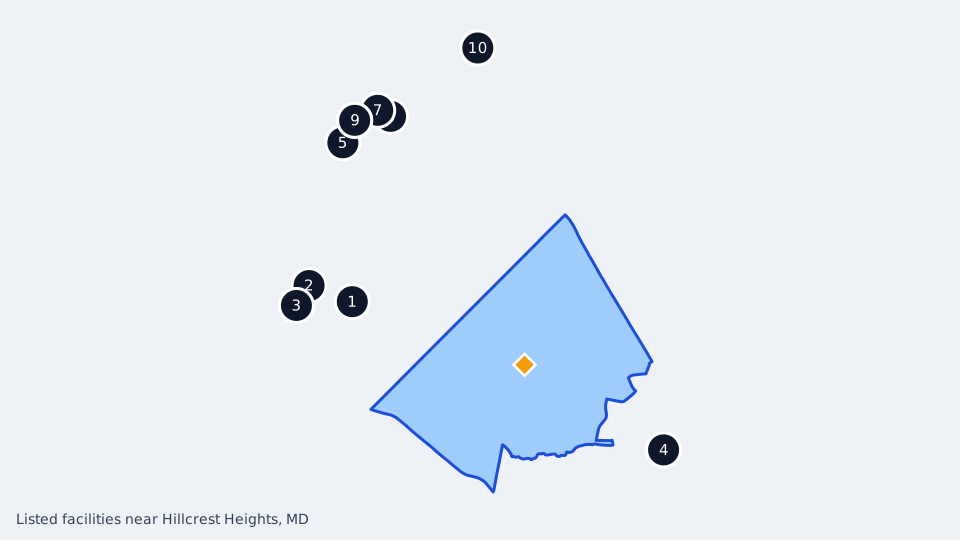
10 options near Hillcrest Heights, MD, nearest first. Compare services and locations, then call to check availability.
This number connects to our central helpline, not directly to a listed facility.
You will speak with a real person who understands what you are going through.
The call is free and confidential, with no obligation to move forward.
You will leave the call knowing exactly what happens next.
If you are looking for alcohol rehab in or near Hillcrest Heights, you are likely thinking about how to take the next step. The first day usually involves an assessment where staff learn about your needs and begin to build a plan that fits your situation.
Call (877) 712-7713
Alcohol rehab generally comes in three levels, and the right one depends on how much danger you're in and how much structure you need. Detox is the first stage for anyone who drinks heavily every day or who has tried to stop and gotten sick. It means medical supervision for the few days it takes the alcohol to leave your system, because withdrawal can bring seizures, hallucinations, and a racing heart.
Residential care means you live at the facility for a set period, usually a few weeks, with therapy, group sessions, and no access to alcohol. Outpatient care means you live at home and come in for treatment during the day or evening, which works better for people with a stable home situation and a milder level of dependence. A simple rule: if stopping cold has ever made you physically ill, or if you drink first thing in the morning, start with detox.
If home is full of stress or easy access to alcohol, residential gives you a real break. If you cannot leave work or family for weeks, outpatient lets you keep your life while you get help.
Call (877) 712-7713Round-the-clock medical monitoring while your body clears alcohol safely.
You live on site for weeks, with therapy and structure every day.
Scheduled sessions while you keep living at home and working.
Ongoing support and check-ins that help sobriety last.
When you call a rehab center for the first time, you do not need to know anything fancy. Start with the practical questions. Ask whether they have a bed or a detox spot open now, or how long the wait is.
Ask what the first day looks like, so nothing surprises you. Ask whether they take your insurance and what you'd owe out of pocket if they don't. Then ask about the medical side: who is on staff, can they treat withdrawal with medication, and would you be transferred to a hospital if something goes wrong.
It's fair to ask how long the program runs and what happens after it ends. Finally, ask the one question people forget: what should I bring with me? A good program answers all of this on the first call without pressure.
How you pay for alcohol rehab in Maryland often involves private health insurance, such as plans from employer-based coverage or the Maryland Health Benefit Exchange. Public systems like Medicare and Maryland’s Medical Assistance program may provide coverage for those who meet specific criteria—always confirm eligibility beforehand. Many facilities operate on a sliding-scale fee model to accommodate different financial situations, and self-pay is another common route for individuals without insurance.
Prospective clients should directly inquire about accepted payment methods at each center.
Comparing rehab centers comes down to a few concrete things, and you can check most of them on one phone call. First, can they handle your situation? If you need detox, a center without medical staff is out.
Second, can you actually get in? A great program with a three-week wait helps you less than a good one with a bed tomorrow. Third, does the money work?
Get the out-of-pocket number, not vague reassurance. Fourth, look at who treats you: licensed counselors, doctors, nurses, versus a program staffed mostly by volunteers. Fifth, consider the distance from home.
Close to home makes family visits and follow-up care easier; far from home puts distance between you and your usual routine. Neither is automatically right. Also ask what happens after discharge, because the weeks after treatment are when relapse risk is highest, and a center that plans for that is thinking about your future, not just your admission.
If you are looking for alcohol rehab in or near Hillcrest Heights, you are likely thinking about how to take the next step.

If you or someone near you is going through severe alcohol withdrawal, treat it as a medical emergency right now. The warning signs are seizures, shaking you can't control, hallucinations, seeing or hearing things that aren't there, severe confusion, a racing heart, or fever. Heavy drinkers who stop suddenly can slide from feeling rough to medically dangerous within hours.
Do not wait to see if it passes. Call 911 or get to the nearest emergency room. Tell the medical staff exactly how much has been drinking and when the last drink was, because that changes how they treat it.
Never try to force someone to tough out withdrawal at home, and never let them sober up alone if they've had seizures before. Emergency departments deal with this every day and can give medication that makes withdrawal safer. Getting help fast is the right call, not an overreaction.
If you or someone else is in immediate danger, call 911 now.
Call (877) 712-77131201 Sycamore Drive SE, 5th Floor, Washington, DC, 20032
Active
2759 Martin Luther King Avenue SE, Washington, DC, 20032
Active
3029 Martin Luther King Jr Avenue SE, Washington, DC, 20032
Active
4400 Stamp Road, Suite 208-B, Temple Hills, MD, 20748
Active
2307 Martin Luther King Jr Avenue SE, Washington, DC, 20020
Active
1427 Marion Barry Avenue SE, Washington, DC, 20020
Active
1320 Marion Barry Avenue SE, Washington, DC, 20020
Active
2041 Martin Luther King Jr Avenue SE, Suite M-8, Washington, DC, 20020
Active
2041 Martin Luther King Avenue SE, Suite 303, Washington, DC, 20020
Active
1301 LEnfant Square SE, Washington, DC, 20020
Active
Free and confidential. Call any time.
These lists use only what the 10 active facilities listed for Hillcrest Heights report to SAMHSA's FindTreatment.gov. No facility pays to be included or can ask to be moved. Reporting more options is not a measure of quality, outcomes or suitability for any person. A missing option means the facility did not report it to the source, not that it is not offered. Call the facility to confirm everything before relying on it.
How this list is made: each facility scores one point for each of these 5 levels of care (settings) it reports to SAMHSA's FindTreatment.gov (Residential (24-hour); Outpatient; Intensive outpatient; Partial hospitalization / day treatment; Hospital inpatient). A facility needs at least 3 to appear. Facilities are shown from the highest count to the lowest; facilities with the same count are in alphabetical order, which has no other meaning. Up to 10 are shown.
How this list is made: each facility scores one point for each of these 7 payment and cost-assistance options it reports to SAMHSA's FindTreatment.gov (Medicaid; Medicare; Private health insurance; Military insurance (TRICARE); Cash or self-payment; Sliding fee scale; Payment assistance). A facility needs at least 4 to appear. Facilities are shown from the highest count to the lowest; facilities with the same count are in alphabetical order, which has no other meaning. Up to 10 are shown.
How this list is made: each facility scores one point for each of these 4 medications used in treatment it reports to SAMHSA's FindTreatment.gov (Buprenorphine; Methadone; Naltrexone; Medication for alcohol use disorder). A facility needs at least 2 to appear. Facilities are shown from the highest count to the lowest; facilities with the same count are in alphabetical order, which has no other meaning. Up to 10 are shown.
How this list is made: each facility scores one point for each of these 12 age groups and client groups accepted it reports to SAMHSA's FindTreatment.gov (Adolescents; Young adults; Adults; Seniors; Pregnant or postpartum women; Adult women; Adult men; Veterans; Active duty military; Criminal justice clients; Clients who have experienced trauma; Co-occurring mental and substance use disorders). A facility needs at least 5 to appear. Facilities are shown from the highest count to the lowest; facilities with the same count are in alphabetical order, which has no other meaning. Up to 10 are shown.
An assessment is a conversation with a counselor who asks about your drinking, health, and personal history. This helps the program understand what kind of support would work best for you.
Not necessarily. Some programs offer outpatient care where you attend sessions during the day and return home each night. Others may offer residential care if you need a more structured setting. The directory lists both options near Hillcrest Heights.
It depends on the level of care and how you respond. Medical detox usually takes under a week. Residential programs commonly run a few weeks to a few months, and outpatient programs often run two to three months or longer with sessions a few times a week. Many people move from one level to the next over several months. The honest answer is that it takes as long as it takes to get stable and build habits that hold up at home.
Most health insurance plans cover alcohol treatment to some degree, including detox and counseling, but the details vary a lot. Call the number on the back of your insurance card and ask what's covered, what your deductible is, and which facilities are in network. Then confirm the same things with the rehab center itself before you commit. Get the out-of-pocket number in writing when you can. If you have no insurance, ask about sliding-scale fees or payment plans.
Detox is the short medical process of getting alcohol safely out of your body, usually under a doctor's care for a few days, because sudden withdrawal can cause seizures and other dangerous symptoms. Rehab is the longer work of changing the drinking itself, through counseling, group therapy, and skill-building, either while living at a facility or attending as an outpatient. Detox handles the physical emergency; rehab addresses why the drinking happens and how to stop. Most people who are physically dependent on alcohol need both.
Last updated