 Sentinel Alcohol Detox

Seacoast Mental Health Center
6.3 mi, Exeter30 Magnolia Lane, Exeter, NH, 03833
Active
- Outpatient
- Medicaid
- Medicare
- Private insurance
City
No listed facilities are in Hampton. The nearest listed facility is 6.3 miles from Hampton. Compare the facilities near Hampton below; distances are straight-line estimates.
This number connects to our central helpline, not directly to a listed facility.
If you are looking for alcohol rehab in Hampton, New Hampshire, you may be close to the Seacoast region, where several counseling centers and outpatient clinics offer substance use treatment. The first day at a program usually begins with an intake appointment, during which a counselor will ask about your drinking patterns, medical history and goals for recovery. Call the program to ask what happens during that appointment, what documents or information you should bring, and what time you should arrive.

You will likely encounter three main levels of care when looking at rehab centers. Medical detox provides around-the-clock monitoring to help you safely stop drinking, often using medications to ease withdrawal. Residential treatment offers a structured, live-in environment with daily group and individual therapy.
Outpatient programs, such as intensive outpatient (IOP) or standard outpatient, let you keep working or caring for family while attending counseling several times a week. To choose, consider how stable your living situation is and how much support you need to avoid relapse.
Before committing, call and ask these three questions: 'How do you handle a person who has a relapse during treatment?' 'What are the qualifications of your clinical staff—are there licensed counselors and a doctor on site?' And 'Do you provide aftercare planning or refer to ongoing support groups once the program ends?'
Facilities across New Hampshire commonly accept a range of private health insurance plans, which may cover some or all of the costs of alcohol rehab services. For those without private coverage, public programs such as Medicaid may offer assistance, though eligibility varies and should be confirmed directly with the program. Many centers also provide sliding-scale fees based on income, and self-pay options are typically available for individuals who prefer to pay out-of-pocket without insurance.
It is essential to verify payment arrangements with each facility before admission.
Comparing options means getting specific. Ask each program about their success rates for completing the program (not cure rates, just completion). Find out whether they have a medical doctor available during detox if you need one.
Also, verify if the program is licensed by the state health department—this is a basic safety check you can do online or over the phone.
If you are looking for alcohol rehab in Hampton, New Hampshire, you may be close to the Seacoast region, where several counseling centers and outpatient clinics offer substance use treatment.

Some withdrawal symptoms can be life-threatening. If you feel shaky, sweaty, or nauseous and these symptoms get worse quickly, or if you see or hear things that are not there, get emergency medical help right now. Call 911.
Do not wait to see if it passes.
If you or someone else is in immediate danger, call 911 now.
30 Magnolia Lane, Exeter, NH, 03833
Active
8 Greenleaf Woods Drive, Portsmouth, NH, 03801
Active
24 Morrill Place, Amesbury, MA, 01913
Active
37 Washington Street, Newburyport, MA, 01950
Active
110 Haverhill Road, Suite 206, Amesbury, MA, 01913
Active
30 International Drive, Suite 101, Portsmouth, NH, 03801
Active
402 Goodrich Avenue, PNSY, Kittery, ME, 03904
Active
207 South Main Street, Newmarket, NH, 03857
Active
177 Shattuck Way, Portsmouth, NH, 03801
Active
62 Brown Street, Suite 505, Haverhill, MA, 01830
Active
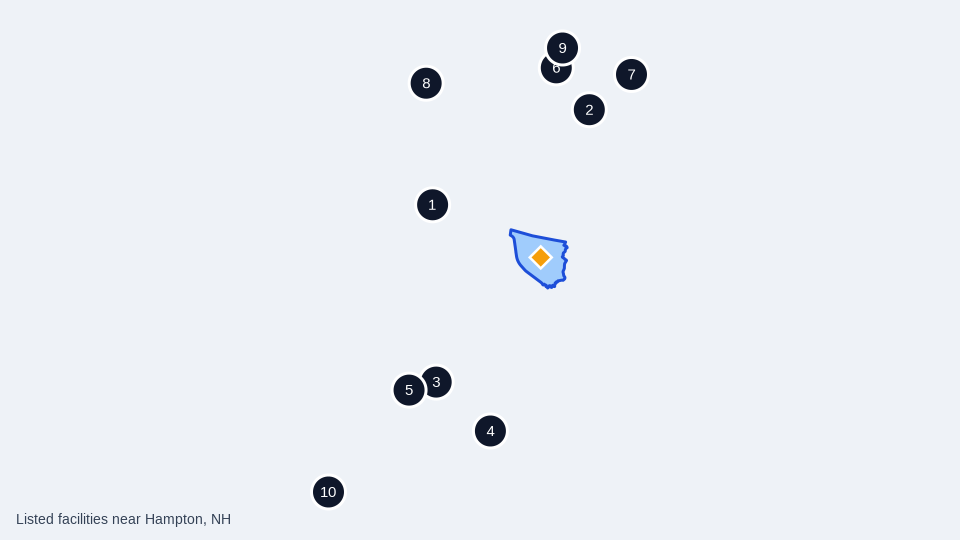
These lists use only what the 10 active facilities listed for Hampton report to SAMHSA's FindTreatment.gov. No facility pays to be included or can ask to be moved. Reporting more options is not a measure of quality, outcomes or suitability for any person. A missing option means the facility did not report it to the source, not that it is not offered. Call the facility to confirm everything before relying on it.
How this list is made: each facility scores one point for each of these 5 levels of care (settings) it reports to SAMHSA's FindTreatment.gov (Residential (24-hour); Outpatient; Intensive outpatient; Partial hospitalization / day treatment; Hospital inpatient). A facility needs at least 3 to appear. Facilities are shown from the highest count to the lowest; facilities with the same count are in alphabetical order, which has no other meaning. Up to 10 are shown.
How this list is made: each facility scores one point for each of these 7 payment and cost-assistance options it reports to SAMHSA's FindTreatment.gov (Medicaid; Medicare; Private health insurance; Military insurance (TRICARE); Cash or self-payment; Sliding fee scale; Payment assistance). A facility needs at least 4 to appear. Facilities are shown from the highest count to the lowest; facilities with the same count are in alphabetical order, which has no other meaning. Up to 10 are shown.
How this list is made: each facility scores one point for each of these 4 medications used in treatment it reports to SAMHSA's FindTreatment.gov (Buprenorphine; Methadone; Naltrexone; Medication for alcohol use disorder). A facility needs at least 2 to appear. Facilities are shown from the highest count to the lowest; facilities with the same count are in alphabetical order, which has no other meaning. Up to 10 are shown.
How this list is made: each facility scores one point for each of these 12 age groups and client groups accepted it reports to SAMHSA's FindTreatment.gov (Adolescents; Young adults; Adults; Seniors; Pregnant or postpartum women; Adult women; Adult men; Veterans; Active duty military; Criminal justice clients; Clients who have experienced trauma; Co-occurring mental and substance use disorders). A facility needs at least 5 to appear. Facilities are shown from the highest count to the lowest; facilities with the same count are in alphabetical order, which has no other meaning. Up to 10 are shown.
When you call, the staff will likely ask about your drinking, any past treatment, your insurance and whether you need help with withdrawal. They can tell you about their program, what services they offer and how to start the intake process. Ask what you should bring, what hours they are open and whether they offer same-day appointments.
Yes, facilities in nearby towns such as Portsmouth, Exeter, Amesbury and Newburyport provide outpatient counseling and treatment for alcohol use. Call to confirm whether a specific program offers outpatient services, group therapy or medication-assisted treatment. Availability and hours vary, so it is best to check directly with the program.
Many health insurance plans cover at least part of alcohol rehab. You should call your insurance company directly and ask about your specific plan's coverage for detox, residential, and outpatient care.
The terms are often used interchangeably. Both mean you stay at the facility 24/7. Some centers use inpatient to describe treatment that also offers medical monitoring, similar to a hospital setting.
Policies vary. Many programs restrict phone and internet use initially to help you focus on recovery. Some allow limited, scheduled use later in treatment. Ask about their technology policy before you choose a program.
Last updated