 Sentinel Alcohol Detox

Fairfax/Falls Church Comm Servs Board
2.1 mi, Chantilly4213 Walney Road, Chantilly, VA, 20151
Active
- Residential
- Detox
- Medication-assisted treatment
- Medicaid
City
No listed facilities are in Greenbriar. The nearest listed facility is 2.1 miles from Greenbriar. Compare the facilities near Greenbriar below; distances are straight-line estimates.
This number connects to our central helpline, not directly to a listed facility.
If you are looking for alcohol rehab in or near Greenbriar, Virginia, the first step is usually an assessment to understand your situation. During an intake, a counselor will discuss your history with alcohol, any health concerns and what you hope to achieve in treatment. Based on the evaluation, the program will suggest a level of care, which may include outpatient therapy, intensive outpatient programs or residential treatment.
Ask the program how its first day works, whether a medical evaluation is needed and what time you should arrive.

The three main levels are detox, residential, and outpatient. Detox is short-term medical care for when your body is physically dependent and you risk seizures or delirium if you stop abruptly. Residential is a live-in program with individual and group counseling, often for 30 to 90 days.
Outpatient means you visit a clinic or attend telehealth sessions two to five times per week, keeping your work and family schedule. You might start with a phone screening by a substance abuse professional who will recommend one level over another. Some programs offer a step-down approach, moving you to less intensive care as you improve.
"What is your typical daily schedule, and do you offer individual therapy in addition to groups?"
Across Virginia, paying for alcohol rehab facilities is most frequently handled through private insurance, which often covers a range of services from detox and residential stays to outpatient support and aftercare planning. Public health coverage through Medicaid or Medicare helps many residents afford treatment, though accurate eligibility and acceptance by the chosen center require prior confirmation. For uninsured individuals, sliding-scale fees adjusted to household income and straightforward self-pay options provide flexible ways to manage costs, with some centers also offering payment plans.
Reach our free, confidential helpline any time, day or night.
A short conversation helps match you with the right level of care.
If needed, withdrawal is managed safely under medical supervision.
You leave with a clear plan for ongoing treatment and support.
Start by calling at least three different centers. Ask each one about their staff credentials, success rates they track, and any alumni support groups. Compare the length of their program; some are fixed at 30 days, others are flexible based on progress.
Consider whether you want a gender-specific program or one that allows family involvement. Read online reviews but take them with caution, as people often only post when they are very angry or very happy. Trust your gut after speaking with the admissions person.
If a program pressures you to commit immediately, that is a warning sign.
If you are looking for alcohol rehab in or near Greenbriar, Virginia, the first step is usually an assessment to understand your situation.

Severe alcohol withdrawal can kill you. Signs to watch for: shaking that will not stop, rapid heartbeat, confusion, fever, or seeing things that are not there. If you or someone else has these symptoms, call 911 right now.
Do not wait. Do not drive yourself. The emergency room can give medicines like benzodiazepines to prevent seizures and keep you safe.
After your body is stabilized, the hospital social worker can help you find a treatment center.
If you or someone else is in immediate danger, call 911 now.
4213 Walney Road, Chantilly, VA, 20151
Active
14554 Lee Road, Chantilly, VA, 20151
Active
11204 Waples Mill Road, Fairfax, VA, 22030
Active
15100 Enterprise Court, Suite 300, Chantilly, VA, 20151
Active
425 Carlisle Drive, Suite B, Herndon, VA, 20170
Active
11415 Isaac Newton Square South, Reston, VA, 20190
Active
4017 Williamsburg Court, Suite 100, Fairfax, VA, 22032
Active
110 Pleasant Street NW, Suite D, Vienna, VA, 22180
Active
9300 Forest Point Circle, Suite 103, Manassas, VA, 20110
Active
10416 Burke Lake Road, Fairfax Station, VA, 22039
Active
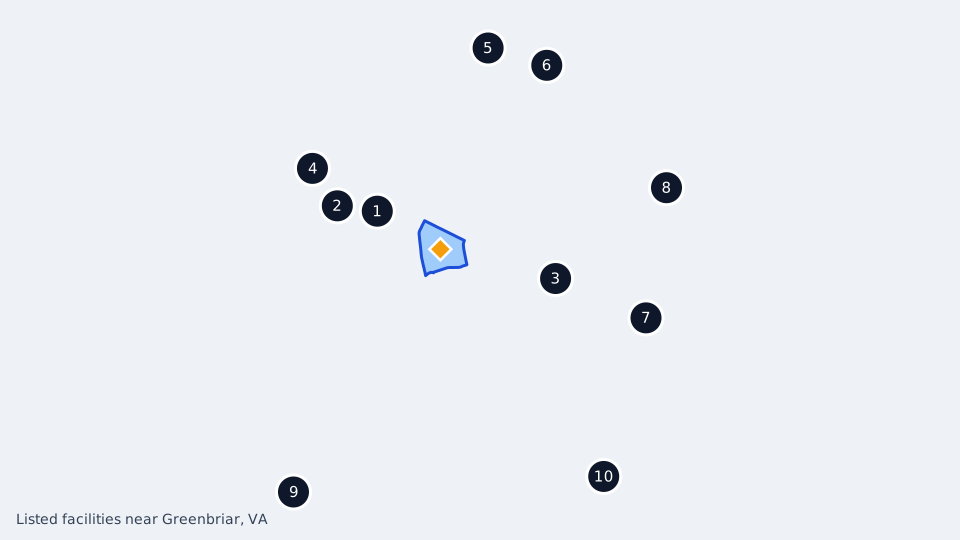
These lists use only what the 10 active facilities listed for Greenbriar report to SAMHSA's FindTreatment.gov. No facility pays to be included or can ask to be moved. Reporting more options is not a measure of quality, outcomes or suitability for any person. A missing option means the facility did not report it to the source, not that it is not offered. Call the facility to confirm everything before relying on it.
How this list is made: each facility scores one point for each of these 5 levels of care (settings) it reports to SAMHSA's FindTreatment.gov (Residential (24-hour); Outpatient; Intensive outpatient; Partial hospitalization / day treatment; Hospital inpatient). A facility needs at least 3 to appear. Facilities are shown from the highest count to the lowest; facilities with the same count are in alphabetical order, which has no other meaning. Up to 10 are shown.
How this list is made: each facility scores one point for each of these 7 payment and cost-assistance options it reports to SAMHSA's FindTreatment.gov (Medicaid; Medicare; Private health insurance; Military insurance (TRICARE); Cash or self-payment; Sliding fee scale; Payment assistance). A facility needs at least 4 to appear. Facilities are shown from the highest count to the lowest; facilities with the same count are in alphabetical order, which has no other meaning. Up to 10 are shown.
How this list is made: each facility scores one point for each of these 4 medications used in treatment it reports to SAMHSA's FindTreatment.gov (Buprenorphine; Methadone; Naltrexone; Medication for alcohol use disorder). A facility needs at least 2 to appear. Facilities are shown from the highest count to the lowest; facilities with the same count are in alphabetical order, which has no other meaning. Up to 10 are shown.
How this list is made: each facility scores one point for each of these 12 age groups and client groups accepted it reports to SAMHSA's FindTreatment.gov (Adolescents; Young adults; Adults; Seniors; Pregnant or postpartum women; Adult women; Adult men; Veterans; Active duty military; Criminal justice clients; Clients who have experienced trauma; Co-occurring mental and substance use disorders). A facility needs at least 5 to appear. Facilities are shown from the highest count to the lowest; facilities with the same count are in alphabetical order, which has no other meaning. Up to 10 are shown.
Programs vary widely. Some offer outpatient counseling, where you attend sessions during the day and return home at night. Others offer intensive outpatient or partial hospitalization programs that require several hours of treatment each day. A few may provide residential care where you stay overnight. Call each program to ask about its specific services, schedule and whether it treats alcohol use.
The right level of care depends on how severe your alcohol use is, whether you have other medical or mental health conditions and what kind of support you have at home. During an assessment, a counselor or clinician can help you understand what level of structure and medical oversight you may need. Talk with a treatment provider to discuss your needs and get a recommendation.
There is no single answer. Detox is generally short—a few days to a week. Residential programs average about a month but can go longer. Outpatient schedules are flexible, often meeting a few hours a week for several months. Your counselor will help decide when you are ready to step down.
Coverage varies by plan. The best way to find out is to call the phone number on your insurance card and ask if they cover detox, residential, and outpatient alcohol treatment. You can also ask the rehab center's billing department to pre-verify your benefits, which they often do for free.
You can, but you may need to adjust your schedule. If you choose outpatient care, many programs offer evening hours. If you need residential, talk to your human resources department about medical leave—substance use treatment is protected under federal law. Some employers also offer Employee Assistance Programs (EAP) that can help arrange care.
Last updated