 Sentinel Alcohol Detox

Wasatch BH Special Servs District
3.0 mi, Spanish Fork3281 North Main Street, Spanish Fork, UT, 84660
Active
- Residential
- Detox
- Medication-assisted treatment
- Medicaid
City
10 options near Spanish Fork, UT, nearest first. Compare services and locations, then call to check availability.
This number connects to our central helpline, not directly to a listed facility.
If you are looking for alcohol detox in or near Spanish Fork, the first step is finding a program that offers medically supervised withdrawal care to help you stop drinking safely. The process usually begins with an assessment where staff review your medical history and substance use. Call each program directly to ask about its admission process, what happens during an initial evaluation, and whether you can start the same day you call.

Think of detox as the medical stabilization phase. It is not the same as treatment. Once the alcohol is out of your system, you move on.
Residential care offers 24-hour support in a structured setting. It works well if you have tried outpatient before and struggled. Outpatient care can start right after detox or be used directly if your withdrawal risk is low.
The choice depends on your medical history, how much you drink, and whether you have people at home who support your recovery.
Ask: 'What happens after detox?' You want a concrete discharge plan, not just a suggestion. Also ask: 'Can family members be involved in my treatment?' If that matters to you, check their policy. Ask: 'How much unsupervised time do you allow during detox?' Facilities differ.
Some allow phone calls and visitors; others limit contact for medical reasons.
In Utah, people often fund alcohol detox through private health insurance plans, though it is critical to check with each facility about accepted insurers and potential out-of-pocket costs. Publicly funded coverage, such as through Medicaid, can help those who qualify, but eligibility and acceptance must be confirmed in advance. Additionally, many centers provide sliding-scale pricing adjusted to a person's financial situation, and self-pay arrangements are a common alternative for covering detox services.
Start with safety. Only consider programs that offer medically supervised detox if you drink heavily or have had withdrawal before. Then think about your personal situation.
Can you take time off work and family responsibilities for a residential stay? If not, look for intensive outpatient detox programs that meet daily in the morning or evening. Read the program's online materials or call them directly to see if you feel comfortable with their approach.
If you are looking for alcohol detox in or near Spanish Fork, the first step is finding a program that offers medically supervised withdrawal care to help you stop drinking safely.

You are in immediate danger if you are so confused you cannot stay awake or know where you are. You may need help breathing. Call 911.
If you have had a seizure or are seeing things that are not there, that is also a medical emergency. Do not drive yourself. Call for an ambulance.
Once you are medically stable, the hospital staff can connect you with an alcohol detox program.
If you or someone else is in immediate danger, call 911 now.
3281 North Main Street, Spanish Fork, UT, 84660
Active
984 South 930 West, Payson, UT, 84651
Active
1157 East 300 North, Provo, UT, 84606
Active
395 West Cougar Boulevard, Provo, UT, 84604
Active
280 West River Park Drive, Suite 200, Provo, UT, 84604
Active
777 North Palisade Drive, Orem, UT, 84097
Active
1350 East 750 North, Orem, UT, 84097
Active
1080 East 800 North, Orem, UT, 84057
Active
1480 East 820 North, Orem, UT, 84097
Active
1472 East 820 North, Orem, UT, 84097
Active
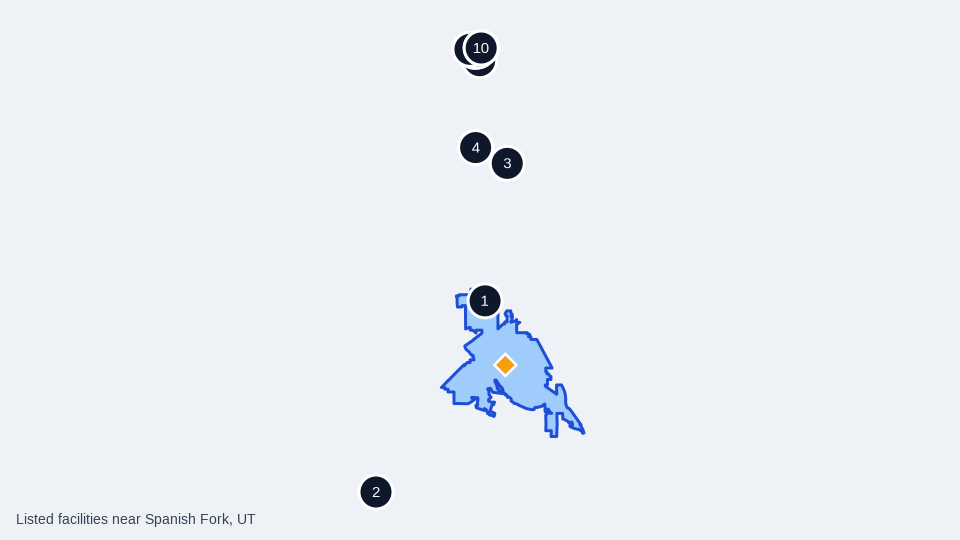
These lists use only what the 10 active facilities listed for Spanish Fork report to SAMHSA's FindTreatment.gov. No facility pays to be included or can ask to be moved. Reporting more options is not a measure of quality, outcomes or suitability for any person. A missing option means the facility did not report it to the source, not that it is not offered. Call the facility to confirm everything before relying on it.
How this list is made: each facility scores one point for each of these 5 levels of care (settings) it reports to SAMHSA's FindTreatment.gov (Residential (24-hour); Outpatient; Intensive outpatient; Partial hospitalization / day treatment; Hospital inpatient). A facility needs at least 3 to appear. Facilities are shown from the highest count to the lowest; facilities with the same count are in alphabetical order, which has no other meaning. Up to 10 are shown.
How this list is made: each facility scores one point for each of these 7 payment and cost-assistance options it reports to SAMHSA's FindTreatment.gov (Medicaid; Medicare; Private health insurance; Military insurance (TRICARE); Cash or self-payment; Sliding fee scale; Payment assistance). A facility needs at least 4 to appear. Facilities are shown from the highest count to the lowest; facilities with the same count are in alphabetical order, which has no other meaning. Up to 10 are shown.
How this list is made: each facility scores one point for each of these 4 medications used in treatment it reports to SAMHSA's FindTreatment.gov (Buprenorphine; Methadone; Naltrexone; Medication for alcohol use disorder). A facility needs at least 2 to appear. Facilities are shown from the highest count to the lowest; facilities with the same count are in alphabetical order, which has no other meaning. Up to 10 are shown.
How this list is made: each facility scores one point for each of these 12 age groups and client groups accepted it reports to SAMHSA's FindTreatment.gov (Adolescents; Young adults; Adults; Seniors; Pregnant or postpartum women; Adult women; Adult men; Veterans; Active duty military; Criminal justice clients; Clients who have experienced trauma; Co-occurring mental and substance use disorders). A facility needs at least 5 to appear. Facilities are shown from the highest count to the lowest; facilities with the same count are in alphabetical order, which has no other meaning. Up to 10 are shown.
Ask if the program provides medically supervised alcohol detox, what the intake process involves, whether you need a referral, and if you can start the same day or the next day. Also ask about hours, location, and what to bring with you.
Some detox programs use medications to manage withdrawal symptoms and reduce discomfort. Call the program to find out which medications, if any, are available and whether a doctor is on site to oversee your care. Treatment decisions should be made with a clinician.
Many detox programs use medications to reduce cravings and prevent serious symptoms. Benzodiazepines are common. Your history determines what is used. A doctor will evaluate you on arrival.
Phone policies vary. Some programs restrict phone use for the first few days to help you focus. Others allow scheduled calls. Ask about their policy before you enroll.
Most health insurance plans cover medically necessary detox. The amount depends on your plan. Call the facility and your insurance company to confirm coverage and any out-of-pocket costs.
Last updated