 Sentinel Alcohol Detox

Recovery Centers of America
5.8 mi, Westminster9 Village Inn Road, Westminster, MA, 01473
Active
- Residential
- Detox
- Medication-assisted treatment
- Medicaid
City
No listed facilities are in Leominster. The nearest listed facility is 5.8 miles from Leominster. Compare the facilities near Leominster below; distances are straight-line estimates.
This number connects to our central helpline, not directly to a listed facility.
If you're looking for alcohol detox care in or near Leominster, you may be feeling ready to take the first step toward stopping drinking and getting support for withdrawal. The first day typically involves a medical assessment to evaluate your symptoms, medical history, and any risks during withdrawal. Call a program to ask about its admission process, what to bring, and whether medical supervision is available around the clock.

Think of detox as the medical stabilization phase. It is not the same as treatment. Once the alcohol is out of your system, you move on.
Residential care offers 24-hour support in a structured setting. It works well if you have tried outpatient before and struggled. Outpatient care can start right after detox or be used directly if your withdrawal risk is low.
The choice depends on your medical history, how much you drink, and whether you have people at home who support your recovery.
Ask: 'What happens after detox?' You want a concrete discharge plan, not just a suggestion. Also ask: 'Can family members be involved in my treatment?' If that matters to you, check their policy. Ask: 'How much unsupervised time do you allow during detox?' Facilities differ.
Some allow phone calls and visitors; others limit contact for medical reasons.
Funding alcohol detox in Massachusetts is handled through various channels. Most private insurance plans have detox coverage; however, coverage varies, so contacting your provider is recommended. MassHealth (Medicaid) may pay for detox services for eligible individuals, but eligibility verification is required.
Some centers provide sliding-scale fees tailored to income, and self-pay is a straightforward option for those without other coverage. Always confirm the exact payment options and accepted plans with the facility you choose.
Reach our free, confidential helpline any time, day or night.
A short conversation helps match you with the right level of care.
If needed, withdrawal is managed safely under medical supervision.
You leave with a clear plan for ongoing treatment and support.
Start with safety. Only consider programs that offer medically supervised detox if you drink heavily or have had withdrawal before. Then think about your personal situation.
Can you take time off work and family responsibilities for a residential stay? If not, look for intensive outpatient detox programs that meet daily in the morning or evening. Read the program's online materials or call them directly to see if you feel comfortable with their approach.
If you're looking for alcohol detox care in or near Leominster, you may be feeling ready to take the first step toward stopping drinking and getting support for withdrawal.

You are in immediate danger if you are so confused you cannot stay awake or know where you are. You may need help breathing. Call 911.
If you have had a seizure or are seeing things that are not there, that is also a medical emergency. Do not drive yourself. Call for an ambulance.
Once you are medically stable, the hospital staff can connect you with an alcohol detox program.
If you or someone else is in immediate danger, call 911 now.
9 Village Inn Road, Westminster, MA, 01473
Active
83 Hospital Road, Baldwinville, MA, 01436
Active
107 Lincoln Street, Worcester, MA, 01605
Active
1369 Grafton Street, Worcester, MA, 01604
Active
2 Courthouse Lane, Unit 2, Chelmsford, MA, 01824
Active
29 North Main Street, Suite 200, Millbury, MA, 01527
Active
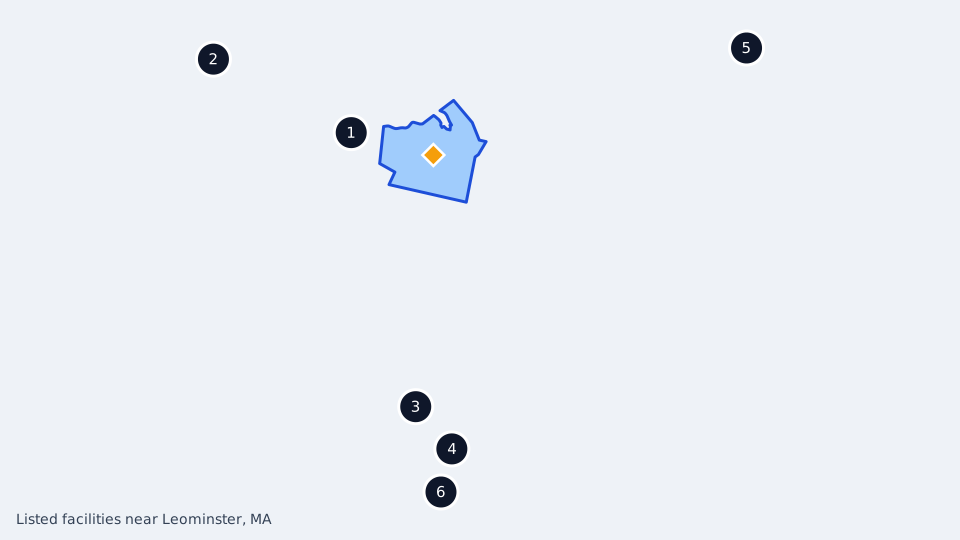
These lists use only what the 6 active facilities listed for Leominster report to SAMHSA's FindTreatment.gov. No facility pays to be included or can ask to be moved. Reporting more options is not a measure of quality, outcomes or suitability for any person. A missing option means the facility did not report it to the source, not that it is not offered. Call the facility to confirm everything before relying on it.
How this list is made: each facility scores one point for each of these 5 levels of care (settings) it reports to SAMHSA's FindTreatment.gov (Residential (24-hour); Outpatient; Intensive outpatient; Partial hospitalization / day treatment; Hospital inpatient). A facility needs at least 3 to appear. Facilities are shown from the highest count to the lowest; facilities with the same count are in alphabetical order, which has no other meaning. Up to 10 are shown.
How this list is made: each facility scores one point for each of these 7 payment and cost-assistance options it reports to SAMHSA's FindTreatment.gov (Medicaid; Medicare; Private health insurance; Military insurance (TRICARE); Cash or self-payment; Sliding fee scale; Payment assistance). A facility needs at least 4 to appear. Facilities are shown from the highest count to the lowest; facilities with the same count are in alphabetical order, which has no other meaning. Up to 10 are shown.
How this list is made: each facility scores one point for each of these 4 medications used in treatment it reports to SAMHSA's FindTreatment.gov (Buprenorphine; Methadone; Naltrexone; Medication for alcohol use disorder). A facility needs at least 2 to appear. Facilities are shown from the highest count to the lowest; facilities with the same count are in alphabetical order, which has no other meaning. Up to 10 are shown.
How this list is made: each facility scores one point for each of these 12 age groups and client groups accepted it reports to SAMHSA's FindTreatment.gov (Adolescents; Young adults; Adults; Seniors; Pregnant or postpartum women; Adult women; Adult men; Veterans; Active duty military; Criminal justice clients; Clients who have experienced trauma; Co-occurring mental and substance use disorders). A facility needs at least 5 to appear. Facilities are shown from the highest count to the lowest; facilities with the same count are in alphabetical order, which has no other meaning. Up to 10 are shown.
Ask whether the program offers medical detox, what medications are used during withdrawal, how long the detox stay typically lasts, and what happens after detox. Also ask about admission requirements, insurance accepted, and whether they serve adults or active military members if that applies to you.
Programs in nearby cities such as Westminster, Baldwinville, Worcester, Millbury and Chelmsford may be options. Call each program to confirm its location and services before you arrange travel.
Many detox programs use medications to reduce cravings and prevent serious symptoms. Benzodiazepines are common. Your history determines what is used. A doctor will evaluate you on arrival.
Phone policies vary. Some programs restrict phone use for the first few days to help you focus. Others allow scheduled calls. Ask about their policy before you enroll.
Most health insurance plans cover medically necessary detox. The amount depends on your plan. Call the facility and your insurance company to confirm coverage and any out-of-pocket costs.
Last updated