 Sentinel Alcohol Detox

Alpine Center for Personal Growth
3.9 mi, Salt Lake City5689 South Redwood Road, Suite 30, Salt Lake City, UT, 84123
Active
- Outpatient
- Detox
- Medicaid
- Medicare
City
No listed facilities are in Kearns. The nearest listed facility is 3.9 miles from Kearns. Compare the facilities near Kearns below; distances are straight-line estimates.
This number connects to our central helpline, not directly to a listed facility.
If you or someone you care about is looking for alcohol detox in Kearns, UT, you are likely facing a difficult moment and want a safe, supervised place to begin. The first day usually starts with a medical assessment to understand your health and the severity of alcohol use. After that, staff can provide 24-hour monitoring and medications to manage withdrawal symptoms.
Call any program beforehand to ask about its admission process, what to bring and whether you can start the same day you call.

Detox is the first step. It is medically supervised withdrawal from alcohol. You stay in a facility for a few days to a week.
Medical staff manage symptoms. It is for people who need 24-hour monitoring during the initial detox phase. Residential treatment comes after detox.
You live at the facility for 30 to 90 days. It provides structured therapy and counseling. It helps you build skills for long-term sobriety.
Outpatient care allows you to live at home. You attend therapy sessions during the day. It works best for people with mild withdrawal risk who have a stable home environment.
To choose between them, ask your doctor about your withdrawal risk and your personal support system.
When you call a program, ask: What medical staff are on site 24 hours a day? Do you use medication to ease withdrawal symptoms? Is there a medical doctor available daily?
What happens after detox – do you help arrange next-step care? Can you verify that your state licenses the facility? Is the detox unit separate from other residents?
What happens if I have a medical emergency during detox? Do you accept my health insurance? How much will it cost without insurance?
Do you have a discharge plan for me after detox ends?
Payment for alcohol detox in Utah commonly involves private insurance, with many plans covering at least a portion of the stay; it is essential to verify your specific coverage and any network restrictions directly with the facility. Public coverage through Medicaid may be available for eligible individuals, though not all programs accept it, so confirming eligibility is advised. Some facilities offer sliding-scale fees based on income, and self-pay options are also usually available for those without insurance or who prefer to pay directly.
Reach our free, confidential helpline any time, day or night.
A short conversation helps match you with the right level of care.
If needed, withdrawal is managed safely under medical supervision.
You leave with a clear plan for ongoing treatment and support.
To choose between nearby options, consider these concrete criteria. First, check state licensing. The facility should have a valid license for detox services.
Second, look at staffing. A good program has a doctor or nurse practitioner assigned to each patient. Third, ask about medication options.
Many detox programs use benzodiazepines to prevent seizures. Fourth, verify they can handle medical complications like high blood pressure or history of seizures. Fifth, ask about transfer agreements with a local hospital.
Sixth, look at the duration. Quality detox programs last at least 72 hours, longer for severe cases. Seventh, check aftercare planning.
Good programs help you arrange residential or outpatient follow-up before you leave.
If you or someone you care about is looking for alcohol detox in Kearns, UT, you are likely facing a difficult moment and want a safe, supervised place to begin.

Severe alcohol withdrawal is a medical emergency. Symptoms can include confusion, rapid heart rate, fever, seizures, or hallucinations (seeing things that are not there). Do not wait at home.
Call 911 immediately. Do not try to detox alone or with home remedies. Go to your nearest emergency room.
Tell them you are withdrawing from alcohol. Emergency medical staff can stabilize you and prevent life-threatening complications.
If you or someone else is in immediate danger, call 911 now.
5689 South Redwood Road, Suite 30, Salt Lake City, UT, 84123
Active
6783 South Redwood Road, Suite 103, West Jordan, UT, 84084
Active
5282 South Commerce Drive, Suite D-110, Salt Lake City, UT, 84107
Active
1875 South Redwood Road, Salt Lake City, UT, 84104
Active
463 East 6865 South, Midvale, UT, 84047
Active
6280 South 725 East, Salt Lake City, UT, 84107
Active
4688 Namba Way, Salt Lake City, UT, 84107
Active
395 East 8000 South, Sandy, UT, 84070
Active
10437 South Jordan Parkway, South Jordan, UT, 84095
Active
3802 South 700 East, Salt Lake City, UT, 84106
Active
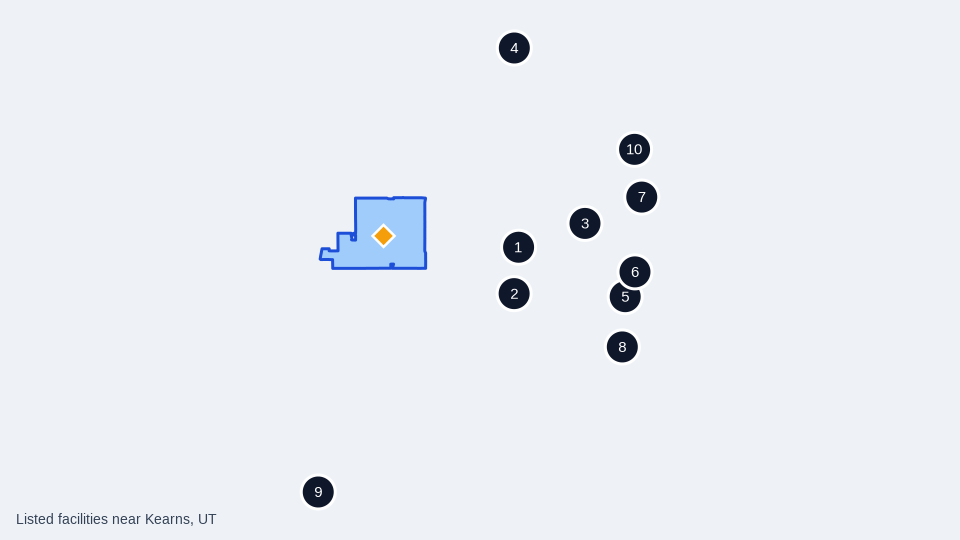
These lists use only what the 10 active facilities listed for Kearns report to SAMHSA's FindTreatment.gov. No facility pays to be included or can ask to be moved. Reporting more options is not a measure of quality, outcomes or suitability for any person. A missing option means the facility did not report it to the source, not that it is not offered. Call the facility to confirm everything before relying on it.
How this list is made: each facility scores one point for each of these 5 levels of care (settings) it reports to SAMHSA's FindTreatment.gov (Residential (24-hour); Outpatient; Intensive outpatient; Partial hospitalization / day treatment; Hospital inpatient). A facility needs at least 3 to appear. Facilities are shown from the highest count to the lowest; facilities with the same count are in alphabetical order, which has no other meaning. Up to 10 are shown.
How this list is made: each facility scores one point for each of these 7 payment and cost-assistance options it reports to SAMHSA's FindTreatment.gov (Medicaid; Medicare; Private health insurance; Military insurance (TRICARE); Cash or self-payment; Sliding fee scale; Payment assistance). A facility needs at least 4 to appear. Facilities are shown from the highest count to the lowest; facilities with the same count are in alphabetical order, which has no other meaning. Up to 10 are shown.
How this list is made: each facility scores one point for each of these 4 medications used in treatment it reports to SAMHSA's FindTreatment.gov (Buprenorphine; Methadone; Naltrexone; Medication for alcohol use disorder). A facility needs at least 2 to appear. Facilities are shown from the highest count to the lowest; facilities with the same count are in alphabetical order, which has no other meaning. Up to 10 are shown.
How this list is made: each facility scores one point for each of these 12 age groups and client groups accepted it reports to SAMHSA's FindTreatment.gov (Adolescents; Young adults; Adults; Seniors; Pregnant or postpartum women; Adult women; Adult men; Veterans; Active duty military; Criminal justice clients; Clients who have experienced trauma; Co-occurring mental and substance use disorders). A facility needs at least 5 to appear. Facilities are shown from the highest count to the lowest; facilities with the same count are in alphabetical order, which has no other meaning. Up to 10 are shown.
Medical detox is generally recommended if you have severe withdrawal symptoms such as shaking, sweating, rapid heart rate, confusion or seizures. Call a program to speak with a professional who can help you decide what level of care is safest for you.
Detox is the first step to stop drinking safely under medical care, but it is not the same as ongoing treatment. After detox, many people continue with counseling, therapy or medication to help maintain recovery. Ask programs about their aftercare planning.
Most alcohol detox programs last 3 to 7 days. The worst symptoms often peak in the first 24 to 48 hours. Your detox length depends on your drinking history and medical needs. The staff will decide when you are medically stable to move on.
Yes. Delirium tremens (DTs) is a severe withdrawal syndrome that can be fatal. Symptoms include confusion, rapid breathing, and seizures. It is not the same as a drug overdose. But it is equally dangerous. Medical detox greatly reduces this risk.
Detox is just the start. It treats the physical dependence but not the behavioral addiction. Without follow-up care, relapse rates are high. Long-term success usually requires residential or outpatient treatment after detox.
Last updated