 Sentinel Alcohol Detox

2907 Pleasant Valley Boulevard, Altoona, PA, 16602
Active
- Outpatient
- Detox
- Medication-assisted treatment
- Private insurance
City
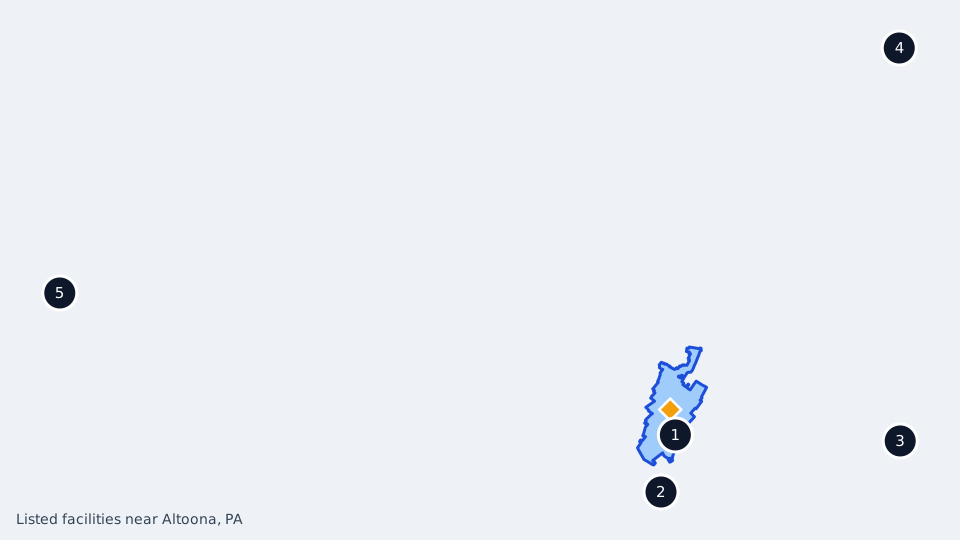
5 options near Altoona, PA, nearest first. Compare services and locations, then call to check availability.
Call (877) 712-7713Free · ConfidentialThis number connects to our central helpline, not directly to a listed facility.
You will speak with a real person who understands what you are going through.
The call is free and confidential, with no obligation to move forward.
You will leave the call knowing exactly what happens next.
If you are looking for alcohol detox care in or near Altoona, the first step often involves an assessment to understand your needs and medical history. A supervised detox program can provide a safe setting where staff monitor your progress and help manage withdrawal symptoms. Typical programs include round-the-clock nursing care, medical check-ins, and support as your body adjusts.
Your first day usually starts with paperwork and a health evaluation, followed by a personalized plan to guide you through the detox process.
Call (877) 712-7713
Detox, residential treatment, and outpatient care are three different levels of help, and knowing the difference makes choosing much easier. Detox is the short first stage: usually three to seven days of medical supervision while alcohol leaves your body and your body recalibrates. Its whole purpose is to keep you safe through withdrawal, because heavy drinking that stops suddenly can cause seizures, hallucinations, confusion, or a racing heart.
You choose detox if you drink daily, drink heavily, have tried to stop before and felt sick, or have any shaking, sweating, or anxiety within hours of your last drink. Residential treatment means you live at the facility for weeks at a time, going through detox if needed and then doing counseling, group work, and planning for life after discharge in one place. You choose residential if your home situation is unstable, if drinking has taken over most of your days, or if you have tried outpatient approaches and kept relapsing.
Outpatient care means you sleep at home and attend treatment sessions during the day or evening, sometimes several days a week. You choose outpatient if you have a safe home, a job or caregiving duties you cannot leave, a support system you can rely on, and withdrawal symptoms that are likely to be mild. A good rule of thumb: when in doubt about safety, start with an assessment at a detox program rather than guessing, because a clinician can tell you in one visit which level you actually need.
Call (877) 712-7713Round-the-clock medical monitoring while your body clears alcohol safely.
You live on site for weeks, with therapy and structure every day.
Scheduled sessions while you keep living at home and working.
Ongoing support and check-ins that help sobriety last.
Before you commit to a program, use your first call to ask the questions that matter, and write them down so nerves do not erase them. Ask whether a doctor will oversee your care and who is on duty around the clock. Ask what medications they use to manage withdrawal symptoms and how they decide when someone needs a hospital instead.
Ask how soon you can be seen and what the intake process involves, including what to bring. Ask whether they accept your insurance, what your estimated share of the cost would be, and whether a payment plan exists if you are paying yourself. Ask whether they screen for depression, anxiety, or other mental health conditions and whether those can be treated at the same time.
Ask what happens after detox: do they arrange the next step before you leave, and do they offer counseling or connect you to local support groups. Finally, ask whether family can be involved in your care if you want them to be. A program that answers all of this plainly, without pressure to commit immediately, has passed the first test.
Across Pennsylvania, people typically finance alcohol detox through private insurance, which may require prior authorization; check with your insurer for coverage details. Public coverage through Medical Assistance (Medicaid) is available for eligible residents, including those under Pennsylvania's expansion, so confirm your status with the state. Many facilities also operate on sliding-scale fees based on your ability to pay and accept direct self-payment, ensuring you explore all financial options during intake.
Reach our free, confidential helpline any time, day or night.
A short conversation helps match you with the right level of care.
If needed, withdrawal is managed safely under medical supervision.
You leave with a clear plan for ongoing treatment and support.
When you compare programs near you, put safety and fit ahead of everything else. First, ask whether the program is licensed and whether a doctor or nurse will actually see you, not just a counselor, because alcohol withdrawal can turn dangerous fast. Second, ask whether they can treat withdrawal with medication rather than willpower alone; programs that ease symptoms with proper medication tend to keep people comfortable enough to finish.
Third, look at how you get in: a program with a clear intake process you can complete this week beats a prestigious one with a vague waiting pipeline. Fourth, ask whether they treat other problems too, since depression, anxiety, or chronic pain often travel with drinking, and a program that ignores them sets you up to relapse. Fifth, check the practical side: whether they take your insurance or offer a payment plan, whether the location is reachable by you or a family member, and whether the visit schedule works with your job or caregiving.
Sixth, ask what happens after the first week, because detox alone is a bridge, and the best programs connect you directly to the next stage of care rather than sending you out the door with a pamphlet. Trust your gut on the phone call too: a program that answers your questions patiently and without judgment is telling you something about how they will treat you in person.
If you are looking for alcohol detox care in or near Altoona, the first step often involves an assessment to understand your needs and medical history.

Stop reading for a moment and take this seriously: severe alcohol withdrawal is a medical emergency, not a rough patch to sleep off. If you or the person you are worried about has seizures, is seeing or hearing things that are not there, is confused about time or place, has a heart racing far beyond normal, is vomiting constantly, or has a fever, call 911 or get to the nearest emergency room right now. Do not wait to see whether it passes, and do not try to drive yourself if you are the one who is ill.
Emergency departments treat withdrawal every day; they can give medication to stop seizures and calm the nervous system safely, and they will not judge you for how much you were drinking. Tell them plainly how much and how often the drinking happened and when the last drink was, because that information determines the treatment. Once the immediate danger is handled, emergency staff can point you toward detox programs and follow-up care, so the ER visit can be the doorway to treatment rather than a dead end.
If you are helping someone else and they refuse to go while showing any of these signs, call 911 anyway and describe exactly what you are seeing.
If you or someone else is in immediate danger, call 911 now.
Call (877) 712-77132907 Pleasant Valley Boulevard, Altoona, PA, 16602
Active
1894 Plank Road, Duncansville, PA, 16635
Active
202 Cove Forge Road, Williamsburg, PA, 16693
Active
134 Jacobs Way, Port Matilda, PA, 16870
Active
170 Father Martin Telenson Lane, Penn Run, PA, 15765
Active
Free and confidential. Call any time.
These lists use only what the 5 active facilities listed for Altoona report to SAMHSA's FindTreatment.gov. No facility pays to be included or can ask to be moved. Reporting more options is not a measure of quality, outcomes or suitability for any person. A missing option means the facility did not report it to the source, not that it is not offered. Call the facility to confirm everything before relying on it.
How this list is made: each facility scores one point for each of these 7 payment and cost-assistance options it reports to SAMHSA's FindTreatment.gov (Medicaid; Medicare; Private health insurance; Military insurance (TRICARE); Cash or self-payment; Sliding fee scale; Payment assistance). A facility needs at least 4 to appear. Facilities are shown from the highest count to the lowest; facilities with the same count are in alphabetical order, which has no other meaning. Up to 10 are shown.
How this list is made: each facility scores one point for each of these 4 medications used in treatment it reports to SAMHSA's FindTreatment.gov (Buprenorphine; Methadone; Naltrexone; Medication for alcohol use disorder). A facility needs at least 2 to appear. Facilities are shown from the highest count to the lowest; facilities with the same count are in alphabetical order, which has no other meaning. Up to 10 are shown.
How this list is made: each facility scores one point for each of these 12 age groups and client groups accepted it reports to SAMHSA's FindTreatment.gov (Adolescents; Young adults; Adults; Seniors; Pregnant or postpartum women; Adult women; Adult men; Veterans; Active duty military; Criminal justice clients; Clients who have experienced trauma; Co-occurring mental and substance use disorders). A facility needs at least 5 to appear. Facilities are shown from the highest count to the lowest; facilities with the same count are in alphabetical order, which has no other meaning. Up to 10 are shown.
Medical detox is generally recommended if you experience withdrawal symptoms like shaking, nausea, confusion, or seizures when you stop drinking. It is safest to have a professional evaluation before starting any detox program. A clinician can help determine the right level of care for you.
Detox is the first step in treatment. After your body stabilizes, most programs recommend continuing with counseling, therapy, or a residential or outpatient program to address the reasons behind alcohol use and build skills for long-term recovery. Your treatment team will help you plan the next steps.
For most people who drink heavily, yes, and the reason is safety rather than comfort alone. Stopping suddenly after heavy, regular drinking can trigger seizures, hallucinations, and dangerous changes in heart rate and blood pressure, sometimes within the first day or two. A supervised detox has medical staff who monitor those risks and use medication to keep withdrawal controlled. If you drink only lightly or occasionally, you may not need a medical detox at all, but let a clinician make that call after hearing your history rather than deciding by guesswork.
For most people it is between three and seven days, though the exact length depends on how much you were drinking and how your body responds. The first two or three days are usually the hardest, with symptoms peaking and staff managing them closely. After that, most people move into a calmer phase where sleep, appetite, and mood slowly settle. Some programs then step you directly into longer treatment, while others hand you off to counseling or outpatient care, so ask before you arrive what happens on day five or six.
For the most part you can expect the facility to handle the medical work, so bring the basics: your ID, your insurance card if you have one, a list of any medications you currently take, and the name of a family member or friend as your contact. Pack simple, comfortable clothes without drawstrings or alcohol-based products like mouthwash or hand sanitizer, since programs remove anything containing alcohol. Leave valuables at home. Call ahead and ask what to bring and what to leave, because each program has its own rules and it is easier to follow them from the start.
Last updated